
Travel Report 2026
“Geography study trip to Kenya (March–April 2026)”
Jambo! Karibu! – Hello! Welcome! We are greeted with these words as soon as we arrive at the airport in Nairobi. At this point, we have no idea that this warm welcome will accompany us every day for the next two weeks. Whenever a questioning look appears on our faces, Kenyans are right there to help us. We are impressed by this great willingness to help.
We – three grammar school teachers from Braunschweig and Wolfsburg – will be visiting nine schools on behalf of Water for Kenya that have received funds, raised through sponsored runs and donations, for building water tanks, farm ponds, school gardens and school kitchens. Also on the program is a visit to a sand dam currently under construction which – also financed by school donations – will support irrigated farming for 400 families.
The drive to Wote in Makueni County in southeastern Kenya is impressive: the hilly landscape is lush green because the rainy season set in very early this year – not necessarily a typical sight for this region in the seasonally humid tropics. Due to climate change, there has been no sustained, reliable rainy season since 2018. Regrettably, this year's heavy rainfall has even caused many deaths, especially in the capital. Everywhere you see terraced farming, livestock husbandry, scattered settlements and small farms. And people are always on foot: on the roads, beside the roads, alongside herds of zebu cattle and goats.
Arriving in Wote is initially a little deceptive: a medium-sized town, yet you search in vain for a classic town center. However, a supermarket with an attached household and furniture section is, much like the markets, a central meeting point for the people.
Working Together with the Local Population
This week we are accompanied and supported by Mary Mutua and Benson Kimote. Benson works for ADSE (Anglican Development Services Eastern) – the implementing organization on the Kenyan side. Mary is an agriculture teacher and is therefore responsible for the sustainable management of the school gardens to ensure the children get a meal. This is an extremely important task in the fight against hunger and as a small contribution against climate change, which is increasingly manifesting itself in the form of droughts. In recent years, the problem of hunger has been an existential one for a great many children and young people.
We travel in four-wheel-drive vehicles along waterlogged dirt roads through the farmland and bushland around the village of Kalawa. The village is 32 km from Wote, a distance that takes around an hour to drive here. We learn that only about 20% of residents have access to electricity in their homes. Many use solar power. For charging phones, there are so-called mobile charge shops, where you can charge your phone for about 20 Kenyan shillings (roughly 13 euro cents).
But it is not only the lives of the people that impress us, but also the nature, with its numerous mango and papaya trees and the sisal plants along the roadside, whose sturdy fibers are used for carpets, baskets and ropes. Especially impressive is the baobab tree: it stores water in its trunk and can thus grow leaves during the dry season, while carrying little or no foliage during the rainy season. Its fruit, mabuyu, is coated in food coloring and sold and eaten as a sweet.
Encounters at the Schools
After a night of heavy rain, the River Kaiti has risen so much that the bridge providing access to the town is badly undermined and barely passable. Our first school visit is due, and because of this heavy rainfall, getting there requires a considerable detour and an almost two-hour drive. As a result, many routes are simply no longer passable because of impassable rivers.
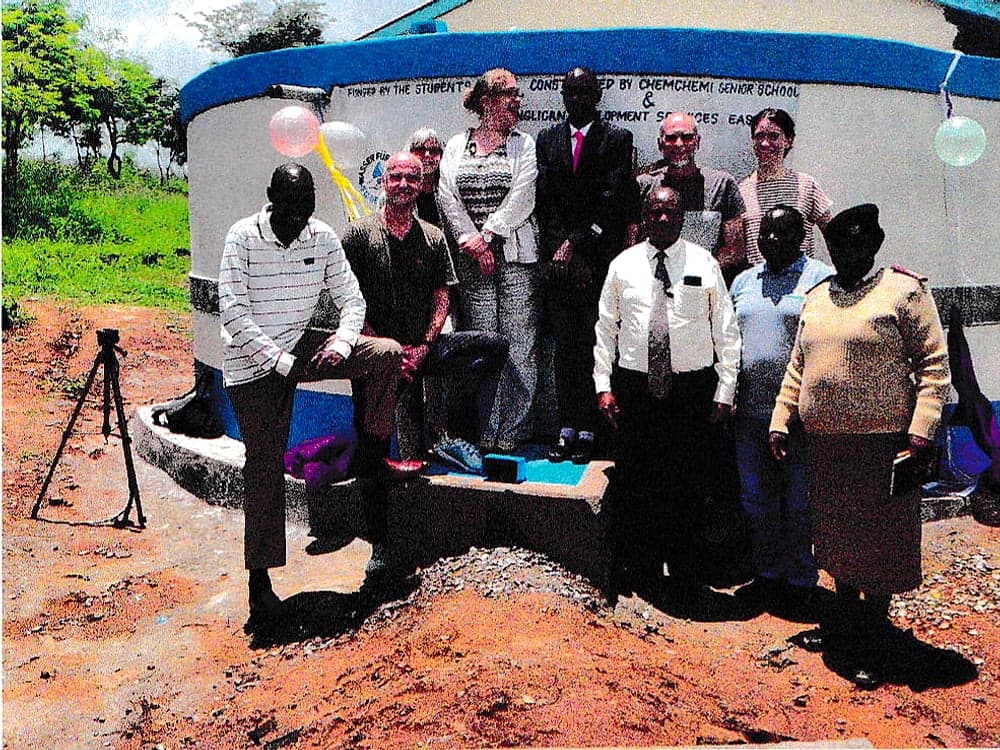
The visit to Chemichemi Secondary School becomes a special experience: a “commissioning” – the inauguration of a water tank – is about to take place. Even as we approach the school grounds, we can hear rousing songs. “Karibu” is truly lived here: after a prayer come the principal's speech, contributions from representatives of ADS Eastern, the local partner organization of Water for Kenya, words of gratitude from parents, and a contribution from our group. Gifts are then exchanged.
We notice that children and adults are out and about bundled up in winter jackets and hats. “It's just still cold,” Mary explains to us, herself shivering. The thermometer in the car shows 23°C at 10 a.m. “It's the rainy season, after all,” she adds.
On the following days too, when we visit eight more schools – this time primary schools (which in Kenya go up to grade 9) – we are always welcomed with prayers, dance, song and an obligatory entry in the guestbook. Again and again we are amazed at how warmly and joyfully we are received by the school communities. Alongside this warmth, we notice that every school has its own motto, such as “Knowledge is power” or “Strive for excellence”.
The school year in Kenya begins in January. Report cards are based on so-called “final exams”. Teaching is often heavily shaped by frontal instruction and dictation. School uniforms, which are often passed down within families, underline this structured framework.
We bring along questions and photos from German students. The Kenyan children are delighted by this glimpse into our everyday school life. In our conversations it quickly becomes clear that one topic connects many people: football and sport. Our gifts of footballs and volleyballs are therefore especially well received and are immediately played with by teachers and children alike. Here, as everywhere in the world, understanding then simply happens, connecting people without the need for many words.
Water for Kenya
At the schools we visit the water tanks, school kitchens and farm ponds (for irrigating the school gardens), which were built with the help of donations from schools through the association Water for Kenya, in cooperation with ADSE, water engineers and the Kenyan school parents. During the short rainy season, rainwater is collected from the schools' large roofs and stored in water tanks for the long dry season.
This allows schoolgirls in particular to attend lessons instead of having to walk long distances to fetch water, as is traditionally the case. The commitment of students from schools in Lower Saxony thus enables, in the spirit of “help toward self-reliance”, education for girls and access to clean water for the entire school community at the schools visited in Kenya.
In direct contact, we experience great gratitude. For the children in Kenya, three pillars are vital for survival: 1. water, 2. food, 3. education. In the dances, poems and songs they perform again and again, they also underline the immense importance of these vital resources.
We become aware that the help provided by our school and other schools in Lower Saxony through the association Water for Kenya truly arrives and is appreciated. During a car ride, Mary asks us how the drinking water supply works in Germany. When we explain that water simply always comes out of the tap, she is stunned, especially that we use it to shower, bathe and wash dishes. This matter-of-fact taken-for-grantedness fills us with great humility.
At the same time, we are troubled by the fact that we witnessed children receiving lunch at only one school. At all the other schools, meals were cooked exclusively for the teaching staff. The children's journeys to school also give cause for reflection: many children walk up to an hour and a half to school every day. Their footwear is often badly worn or not available at all. On top of this, there is a serious problem with insects that lay their eggs in the children's feet, which makes walking difficult and causes illness.
Basic everyday items are also often lacking: teeth are cleaned not with toothbrushes but with small twigs, and the children's hair is usually cropped short, since water for personal hygiene is scarce in the households.
From Wote to Amboseli National Park
After a week we leave Wote heading south and repeatedly encounter large accumulations of rubbish. Yet the Kenyan government introduced a ban on plastic bags back in 2017. Violations can be punished with fines of up to €33,000. This ban is a response to the massive environmental problems caused by plastic waste. In the national parks, increasing efforts are being made to educate visitors about the consequences of litter, for example through information boards.
The closer we get to Amboseli National Park, the more imposingly Mount Kilimanjaro rises up. As the highest free-standing mountain in the world (5,895 m), it lends a special quality to every scene, whether with elephants, zebras or giraffes. It also remains visible for a long time on the way to Tsavo West National Park. The regions of Tsavo East and the Taita Hills appear unusually green – the image of a dry, yellow-brown savanna seems almost unimaginable at this moment.
In Buchuma, between Tsavo East and West, our paths finally part. One colleague travels back to Nairobi by train, while the other two continue on to the Indian Ocean.
The closer we get to the coast, the taller the buildings become, and tourism becomes increasingly visible. Especially striking are the numerous tuk-tuks – there are said to be up to 15,000 in the greater Mombasa metropolitan area, some already solar-powered. The roads also show stark contrasts: modern sections alternate with large potholes. The newer roads were largely built by Chinese companies, sometimes mockingly referred to by locals as “plastic roads”.
Mombasa itself welcomes visitors with the famous elephant tusks that span Moi Avenue as a landmark. They were erected in 1952 as a symbol of welcome for the then British heir to the throne, Elizabeth II. Nearby, thousands of bats live in Uhuru Garden – an impressive contrast between nature and urban space.
In the old town of Mombasa there are spice and textile markets, and many buildings are reminiscent of the colonial era. The front doors marked with chalk are striking: these marks indicate whether children under five in the household have been vaccinated in the past three years. Standard vaccinations, such as against tetanus and polio, are free of charge.
Kenya's second-largest city surprises with a mix of modern buildings and historic architecture. In the middle of the city lie a golf course, government buildings and residential houses along the coast. The city center is connected via a bridge to the north and ferry links to the south.
The ferry crossing makes the contrasts particularly clear: a ferry departs every 15 minutes, carrying up to 1,000 people alongside around 15 cars. On arriving at the other shore, a completely different reality emerges, shaped by poverty and difficult living conditions.
China in Africa – by Rail to Nairobi
In the former British drive to colonially develop East Africa, in a race with other competing European powers, the ambitious plan arose in 1896 to build a railway from the Indian Ocean into the interior of the continent. Construction of the so-called Uganda Railway began that same year – a project that also earned the name Lunatic Line. By 1904, the railway construction had reached Lake Victoria.
More than a century later, another major infrastructure project was implemented in the same region: the rail link between Mombasa and Nairobi. Between 2013 and 2017, a 472-kilometer, single-track, standard-gauge line was built. Around 25,000 Kenyans were involved in the construction. The project was financed 90% by the Chinese Export-Import Bank, with Kenya covering the remaining 10%.
The line climbs 1,661 meters in elevation and is not electrified. Especially in the area of Tsavo East and West National Parks, it has been fenced off, with underpasses for wildlife. Large sections run on embankments or elevated tracks to ensure as straight a route as possible.
At Voi station, you experience an abrupt contrast: the savanna's nature gives way to a strictly organized, clean and tightly controlled infrastructure. Multiple security checks, video surveillance and clear procedures are strongly reminiscent of China – “China in Africa”.
Right on time at 9:55 a.m., the train leaves the station. Traveling at a top speed of 110 km/h, it runs parallel for a long stretch to the busy and accident-prone Mombasa Road, an important transport route toward Uganda and the Congo. Expanding the road infrastructure here remains a major challenge for the future.
After four and a half hours and five stops, the train reaches Nairobi Terminus. There too, elevated toll expressways built by China shape the cityscape.
The journey through Kenya and the visits to the schools were more than enriching for us. They vividly demonstrated how valuable clean water, food and education are – basic human rights and needs that we take for granted, but which are held in extraordinarily high regard here in Kenya precisely because they are not an everyday matter.
And finally, it is time to say goodbye. With one last “Kwaheri, Kenya!” – Goodbye, Kenya! – we set off on our journey home.
Text & photos: Anne Günzl and Dr. Jürgen Gericke. Published in GidS 107, Landesverband Niedersachsen.
Original article as PDF (PDF in German)